
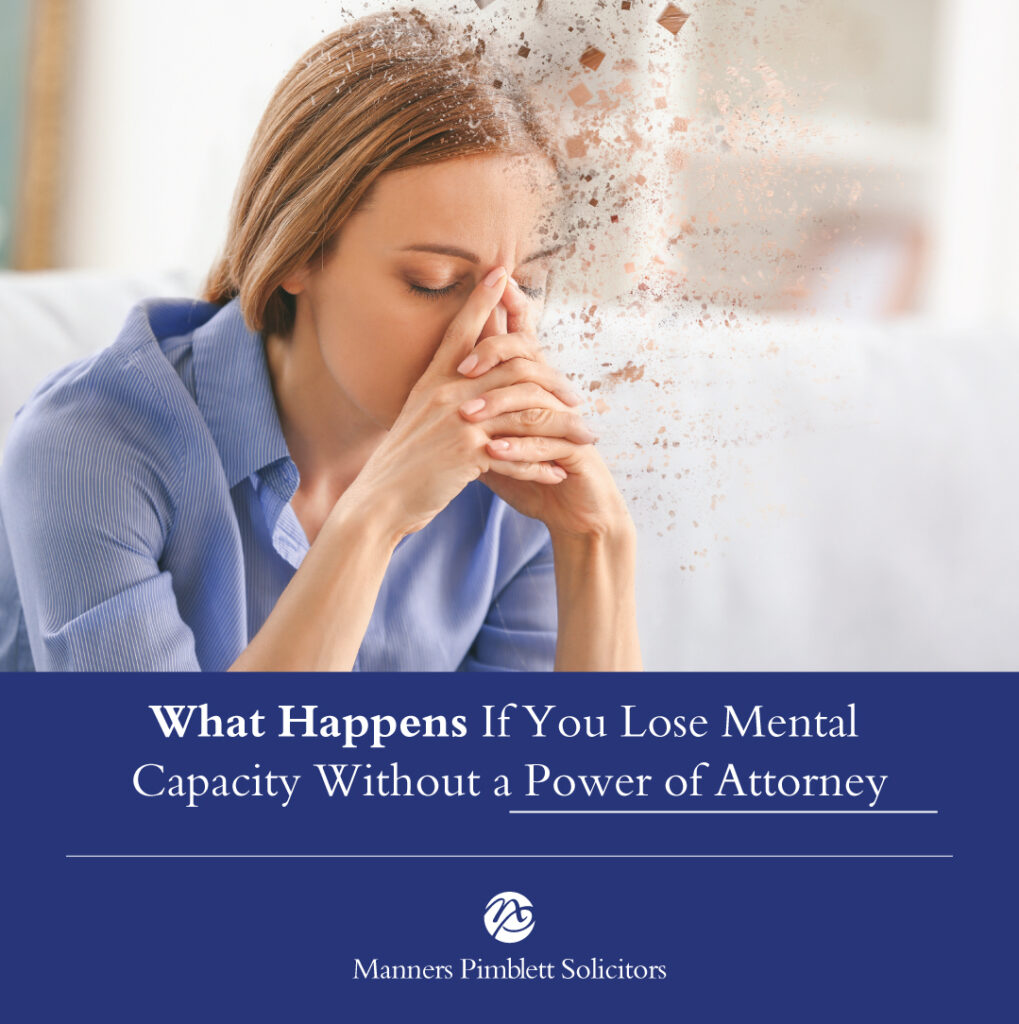
Imagine this. Your elderly mother has a stroke. She is alive, but she can no longer communicate or make decisions for herself. You want to help — to pay her bills, manage her savings, make sure she gets the right care. But when you contact her bank, they tell you they cannot speak to you. When you try to access her accounts, the door is closed. You are her child. You love her. But legally, you have no authority to act.
This is not an unusual scenario. It is one that families across Stockport, Poynton, Cheadle and Cheshire face every year — and in almost every case, it could have been avoided with one straightforward legal document: a Lasting Power of Attorney.
At Manners Pimblett Solicitors, Edith Longden helps clients put Lasting Powers of Attorney in place every week. She also sees, first-hand, the distress that families experience when they have not. In this article, we explain in plain terms exactly what happens when someone loses mental capacity without an LPA — and what options are available to their family.
First
What Does ‘Losing Mental Capacity’ Actually Mean?
Mental capacity, in a legal sense, refers to a person’s ability to make and communicate their own decisions. Under the Mental Capacity Act 2005, a person lacks capacity if they are unable to:
- Understand information relevant to a decision
- Retain that information long enough to make a decision
- Weigh up the information to arrive at a decision
- Communicate their decision
Capacity can be lost suddenly — through a stroke, accident, or medical emergency — or gradually, through conditions such as dementia or Alzheimer’s disease. It can also be temporary, as in the case of a serious illness or period of unconsciousness.
Importantly, capacity is decision-specific. A person may have capacity to make some decisions but not others. However, when capacity is lost in a significant or global way, the legal and practical consequences for their family can be profound.
Finances
What Happens to Someone’s Finances?
Bank Accounts Can Be Frozen and Bills Left Unpaid
When a person loses mental capacity and has no Property and Financial Affairs LPA in place, their financial affairs can become effectively frozen. Banks and financial institutions are legally required to protect their customers’ assets and will not allow third parties — including family members — to access accounts without proper legal authority.
This means that even joint account holders may face restrictions on what they can do. A spouse may be able to access a joint current account for day-to-day expenses, but sole accounts, savings, investments and pensions will typically be inaccessible.
The practical consequences can be severe:
- Mortgage or rent payments falling into arrears
- Utility bills and council tax going unpaid
- Pension payments or benefits not being properly managed
- Property being impossible to sell or manage
- Investments going unmanaged at a potentially critical time
All of this falls on the family — who are already dealing with the emotional shock of their loved one’s condition — and yet they may find their hands are completely tied.
Healthcare
What Happens to Healthcare and Care Decisions?
Without a Health and Welfare LPA, Your Family May Have No Legal Say
The consequences extend beyond finances. Without a Health and Welfare LPA, medical professionals are not legally required to consult family members when making treatment decisions for someone who has lost capacity.
Doctors and care teams will always act in what they believe to be the patient’s best interests — but without a Health and Welfare LPA, they have no formal obligation to follow the wishes of a spouse, child or sibling. Decisions about medical treatment, care home placements, and even end-of-life care can be made without meaningful input from the family.
For many families, this is the most distressing aspect of all. Not knowing whether a loved one’s personal wishes and values are being considered — or being excluded from conversations about their care — can cause lasting emotional harm.
A Health and Welfare LPA changes this entirely. It gives the appointed attorney the legal authority to be involved in all care and treatment decisions, and if the donor has chosen to include it, the right to consent to or refuse life-sustaining treatment on their behalf.
Legal
The Only Legal Alternative: Applying to the Court of Protection
A Process That Is Lengthy, Costly and Stressful — but Often the Only Option
If someone loses mental capacity without an LPA in place, their family’s only legal recourse is to apply to the Court of Protection to be appointed as their deputy. This is a formal court process that carries significant burdens.
The process typically involves:
- Completing detailed application forms and medical evidence
- Paying court fees — currently £371 for a property and affairs deputyship application
- Waiting many months for the application to be processed
- Obtaining a security bond (an insurance policy required by the court)
- Submitting annual accounts and reports to the Office of the Public Guardian
Total costs — including legal fees, court fees, the security bond and annual supervision fees — can run to several thousand pounds. And throughout the application process, which can take six months or more, the person’s financial affairs remain in limbo.
Even once a deputy is appointed, they operate under ongoing court supervision — a level of scrutiny that an LPA attorney does not face. The freedom and flexibility that comes with an LPA simply cannot be replicated through the deputyship process.
Urgent
What About Urgent Situations — Is There Any Emergency Option?
In urgent cases — where a decision needs to be made quickly and there is no time to wait for a full Court of Protection application — it is possible to apply for an emergency or interim order. These can be granted more quickly, but they are limited in scope, expensive, and still require court involvement.
Some banks also have their own vulnerable customer processes that may allow limited access to funds in urgent circumstances, but these are discretionary and inconsistent across institutions.
The honest answer is that there is no easy emergency alternative to an LPA. Every option available when capacity has already been lost involves more time, more cost and more stress than simply having an LPA in place from the outset.
Solution
The Solution Is Simple — and It Starts With a Conversation
Setting up a Lasting Power of Attorney is a straightforward process when done at the right time — meaning while the person still has full mental capacity. At Manners Pimblett Solicitors, Edith Longden guides clients through the process clearly and compassionately, ensuring that the document accurately reflects their wishes and is properly registered with the Office of the Public Guardian.
There are two types of LPA, and we typically recommend that clients consider setting up both:
- Property and Financial Affairs LPA — gives your attorney authority to manage your bank accounts, pay bills, manage property and handle financial decisions
- Health and Welfare LPA — gives your attorney authority to make decisions about your medical treatment, care and day-to-day welfare
Once registered, an LPA gives both you and your family enormous peace of mind. You know that if the worst happens, the right person is in place to act on your behalf — guided by your wishes, not left to navigate a complex legal process in a moment of crisis.
Don’t Leave Your Family in the Dark
Losing mental capacity is frightening enough. The last thing anyone wants is for the people they love to be left helpless, facing legal battles and financial uncertainty at the worst possible time.
A Lasting Power of Attorney is one of the most important gifts you can give your family — and yourself. It costs far less in time, money and stress to set one up now than to deal with the consequences of not having one later.
If you live in Poynton, Cheadle, Stockport or the wider Cheshire area and would like to talk through your options, Edith Longden at Manners Pimblett Solicitors is ready to help.
Talk to Us About a Lasting Power of Attorney
Whether you are thinking about your own future or helping a loved one plan ahead, Edith Longden at Manners Pimblett Solicitors can guide you through the process with care and clarity. Get in touch today for a no-obligation conversation.
📞 01625 850888 | ✉ info@mannerspimblett.co.uk
Offices in Poynton and Cheadle, serving clients across Stockport, Cheshire and the surrounding area.
Find Out More About Powers of Attorney
Also read: 5 Reasons You Should Set Up a Power of Attorney Before You Need One